
Many businesses sell to trade customers and consumers at the same time. Running them as separate storefronts often means duplicated catalogues, split stock and integrations built twice.
Why separate storefronts create drag
Two storefronts usually start as the quickest way to reach a second audience. Over time the cost shows: product data maintained twice and drifting apart, each channel guessing at the other's availability, and ERP, payment and shipping integrations built and supported for each site.
Customers do not always fit neatly either. The same person may be a consumer, a dealer, an employee or a buyer in different contexts.
A shared operational core
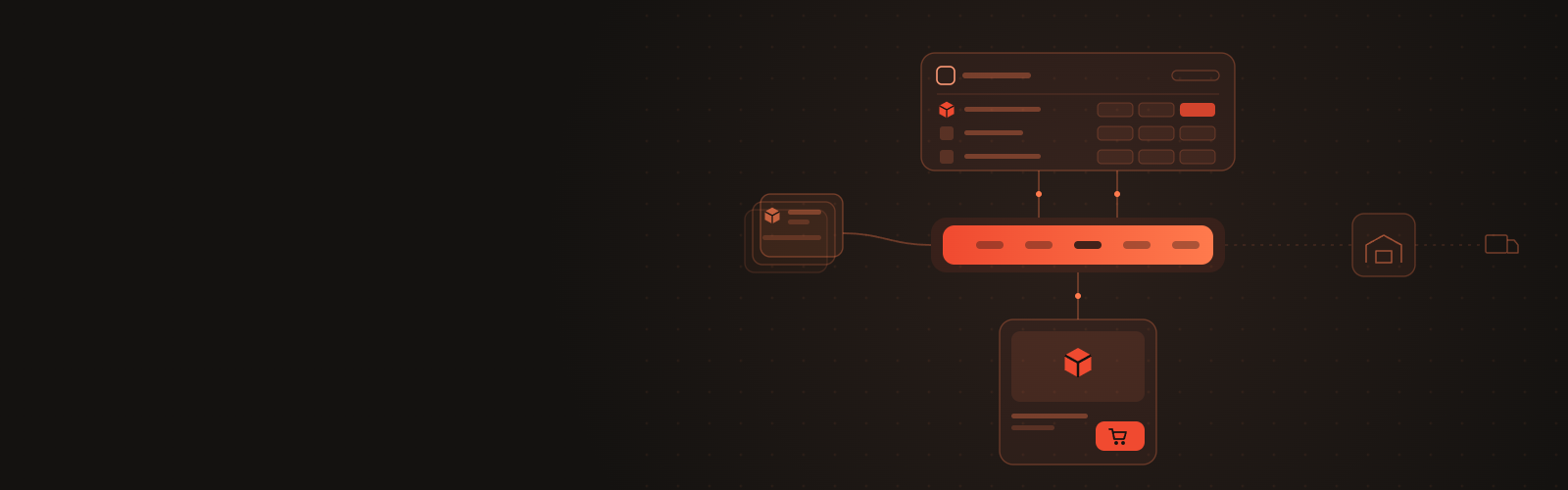
The alternative is to build the operation once. Products, inventory, orders, customer identity and fulfilment services are shared and reused where appropriate, while ERP, PIM, WMS, CRM and reporting remain the governed systems of record.
Different journeys on top
On top of that core, each audience gets the experience it needs. Trade and account customers see negotiated pricing, credit, approvals, purchase orders and account tools. Direct consumers see retail pricing, card payments, promotions, discovery and self-service. The commercial rules differ; the data underneath does not.
Patterns from our work
The same idea shows up in different shapes:
Versatile Packaging - SAP account pricing and retail checkout on one storefront.
G7th - direct, dealer and artist journeys on one codebase.
Troo Health Care - D2C subscriptions and B2B white-label operations connected through shared inventory.
Bringing storefronts together in phases
You do not need to merge everything at once. A phased approach can preserve working operations while audiences and shared services are brought together over time. Explore our case studies or read more about hybrid commerce.
Two systems, or one connected architecture
Separate storefronts
Duplicated catalogues, split stock and integrations built and maintained per site.
Connected hybrid platform
One catalogue, one availability picture and integrations built once, with audience-aware journeys on top.
What to take away
Channels differ in pricing, terms and journey - not in the data underneath them.
Share the operational core; tailor the experience for each audience.
Keep ERP and other systems of record in charge of the data they own.
Merge existing storefronts in phases where that protects the operation.